Introduction


The purpose of this forum is to introduce notable papers and books published by you and other persons. The work can be new or old, but it should be of wide interest and high quality. A brief comment on the significance of the work should be attached. The current categories of the subjects are (1) adaptation, (2) behavioral evolution, (3) dosage compensation, (4) evo-devo, (5) gene evolution, (6) genomic evolution, (7) molecular phylogeny, (8) natural selection, (9) phenotypic evolution, (10) sensory receptors, (11) sex chromosomes, (12) sex determination, (13) speciation, (14) symbiosis and evolution, and (15) horizontal gene transfer. However, new categories can be added if necessary. Emphasis will be given on the biological work rather than on the mathematical. Any person may post a paper by sending it to one of the editors listed below. We also welcome your comments on posted work, but we moderate all the comments to control spam. This forum is primarily for scientific discussion and to construct a database for good molecular evolution papers.


Showing posts with label Sex determination. Show all posts

Friday, June 1, 2012

Rodents with No Y Chromosome and Decay of the Human Y

            In my previous commentary on the sex determination of Tokudaia spiny rats dated May 21, 2012, I mentioned that Amami and Tokunoshima spiny rats (T. osimensis and T. tokunoshimensis) have no Y chromosome and no Sry gene and their sex chromosome type is XO in both males and females and that the gene contents of the male X and the female X chromosomes must be different. However, examining ten genes that are related to sex determination, Kuroiwa et al. (1) concluded that the two chromosomes contain the same set of genes. This suggests that my statement was incorrect (A. Kuroiwa, personal communication).
            However, this does not necessarily exclude the possibility that there may be some sex-determining genes located on the X chromosomes. This possibility is supported to some extent by the mechanism of formation of XO zygotes. Because both males and females have the XO chromosome type, they should produce the gametes with one X or no X chromosome in both sexes. Therefore, the offspring may have genotypes XX, XO, and OO with the probabilities of ¼, ½, and ¼, respectively. However, genotypes XX and OO are not observed, so that they must be lethal. Why is the genotype XX lethal? If the male X (Xm) and the female X (Xf) are identical and normal, the genotype XmXf should be viable and be able to establish the XX genotype in the population. One possible explanation for the absence of XX (or XmXf) and the persistence of only XO could be that Xm and Xf carry the male and the female-determining genes which are incompatible with each other and therefore XmXf individuals will die. Of course, this is an overstretched interpretation at present, and we need to study the genes located on the male X and the female X chromosomes more extensively.
            Kuroiwa et al. identified copies of Cbx2 genes on two autosomal chromosomes in each of the two Tokudaia species, and the number of copies was higher in males than in females. One of the two chromosomes is linked to the Sox9 gene, as in the case of other mammalian species, and therefore the Cbx2 gene located on this chromosome appears to be the original one, and other Cbx2 genes located on the other chromosome are considered to be the genes transferred from the original chromosome and then duplicated. Kuroiwa et al. speculated that these duplicate Cbx2 genes are responsible for testis formation because the Cbx2 genes are known to suppress ovary development in humans and mice. Kuroiwa (personal communication) then suggests that the new chromosome carrying more Cbx2 genes has become a neo-Y chromosome and the homologous chromosome carrying a smaller number of Cbx2 genes has become a neo-X chromosome.  
            This is an interesting suggestion, but it is not without deficiencies. First, there is no proof that a larger number of Cbx2 copies is really responsible for sex determination. Second, there must be a recombination reduction in the duplicate gene region to keep the duplicate genes together. Otherwise, the neo-Y chromosome cannot be isolated from the neo-X chromosome (2). Once no recombination system evolves in this region, lethal mutations are expected to accumulate particularly in small populations (3). At the present time, no such evidence seems to exist.
            Of course, identification of the sex determination gene in these species would be very difficult because the population size of Amami and Tokunoshima spiny rats is very small and protected by the Japanese government. Therefore, one cannot get even small samples easily. Nevertheless, it would be important to clarify the evolutionary mechanism of the XO/XO type, because this would give some insight into the general pattern of Y chromosome evolution.
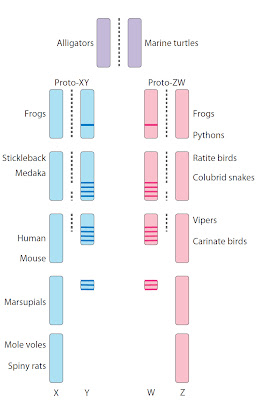
Fig.1. Degeneration of the sex-specific element (Y or W) from an original autosome (purple) to form more or less differentiated XY (blue) or ZW (pink) sex chromosome pairs. Degraded Y chromosomes harbor male-specific genes (blue lines) and W harbor female-specific genes (pink lines). Examples of vertebrate species that exhibit this level of differentiation of XY or ZW chromosomes are given on the left or right, respectively. Dotted lines represent pairing and recombination.      From Graves (5).

            Jennifer Graves (4; 5; 6) has repeatedly argued that the human Y chromosome is subject to a high rate of deleterious mutation and appears to become extinct in about ten million years. It is known that only 50 out of the 1,500 genes that existed in the original Y chromosome are surviving currently in the human chromosome. She states: “Accelerated degeneration of the Y chromosome is found in 5 – 15% of severely infertile men whose infertility is caused by wholesale deletion of parts of this chromosome.” She envisages that once the Y chromosome is lost, a new set of sex chromosomes like those of Tokudaia spiny rats must be generated.
            In principle, I disagree with her, because strong purifying is operating for keeping all Y chromosome genes required for male fertility and formation of male phenotype. However, if contraception practice becomes more popular and each married couple produces a smaller number of offspring, the purifying selection will be weaker. It is then possible that infertile men increase and the probability of decay of the Y chromosome genes may be enhanced. In this case the formation of a new sex determination system similar to that of Tokudaia could be one solution. However, because humans can control their evolution, it is unlikely for this event to happen.

References
2. Nei, M. 1969. Linkage modification and sex difference in recombination. Genetics 63:681-699.
4. Aitken RJ, and Marshall Graves JA. 2002. The future of sex. Nature 415:963.
6. Griffin DK. 2012. Is the Y chromosome disappearing?--both sides of the argument. Chromosome Res 20:35-45.

Monday, May 21, 2012

Rodents with No Y Chromosome and No Sry Gene

In mammalian species sex is determined by the X and Y chromosomes. Individuals with two X chromosomes (XX) become female, and those with one X chromosome and one Y chromosome (XY) will be male. This occurs because the Y chromosome carries an Sry gene, which is a transcription factor and triggers the developmental pathway for testis formation. In the absence of the Sry gene, the developmental pathway for ovary formation is chosen as a default option.


Fig. 1. Evolution of sex chromosomes, SRY, and CBX2 in the genus Tokudaia. a Evolutionary events inferred from the present study (red) and previous studies (black) are shown in the phylogeny, together with the geographical distribution of Tokudaia species. Ma: million years ago. b Adult female of Okinawa spiny rat.  c Sub-adult male (2).


Fig. 2. Karyotypes of Amami and Tokunoshima spiny rats (3).

However, there are exceptional species in rodents. Two species of the genus Tokudaia living in small islands called Amami Oshima (T. osimensis) and Tokunoshima (T. tokunoshimensis) near Okinawa, Japan, have neither the Y chromosome nor the Sry gene (Fig. 1). Furthermore, both males and females of these species have only one X chromosome, so that their sex chromosome type is XO in both sexes. In addition, the number of autosomal chromosomes is different between the two species. T. osimensis (Amami spiny rat) has 24 autosomal chromosomes, whereas T. tokunoshimensis (Tokunoshima spiny rat) has 44 autosomal chromosomes (Fig. 2). The genus Tokudaia have three species, and the remaining one (T. muenninki) lives in Okinawa Island. This Okinawa spiny rat has the normal sex chromosome type XX/XY, and the number of autosomal chromosomes is 42.
Molecular phylogenetic analysis has suggested that Okinawa spiny rats diverged from the other two Tokudaia species about 2.5 million years ago and Amami and Tokunoshima spiny rats diverged about one million years ago. Therefore, the chromosome number has changed rapidly in these species by means of fusion, fission, inversion, deletion, translocation, etc. In fact, there is evidence that the chromosomes of Okinawa spiny rat have also experienced structural changes frequently. However, these chromosomal changes are not surprising because chromosomes can change quite often in small populations.
The surprising finding here is that the Sry gene has been lost and the male and the female are determined by the male and the female X chromosomes, respectively. Therefore, the gene contents of the male and the female X chromosomes must be different. In a recent paper Kuroiwa et al. (1) studied this problem by examining the copy number and chromosomal location of 10 genes (Artx, Cbx2, Dmrt1, Fgf9, NroB1, Nr5A1, Rspo1, Sox9, Wnt4, Wnt1) that are concerned with the differentiation of gonads into testis or ovary. The reason why they studied these genes is that duplicates of these genes are often used as signal proteins for sex determination in other organisms such as birds, frogs, and medaka fish. They then found that there are multiple copies of Cbx2 genes in the Tokudaia species and that there are two or more copies of Cbx2 genes in males than in females in both Amami and Tokunoshima spiny rats. Because the Cbx2 gene is known to repress ovarian development in mice and humans, they concluded that a larger number of Cbx2 genes in males is probably responsible for testis development. However, this hypothesis has not been confirmed by isolating and characterizing the Cbx2 genes.
There are two more rodent species which have the XO/XO sex chromosome type in both males and females. They are mole voles (4), and their effective population size again appears to be small. At present, the evolutionary change of the sex determination system in mammals is believed to be rare, but this may not be the case if we examine the sex chromosomes in species of small population size.
In reptiles, amphibians, and fish the sex determination system is known to change rapidly in the evolutionary process. Particularly in reptiles, there are the genetic sex determination (GSD) including both the XY and ZW systems and the temperature dependent sex determination (TSD), and these systems are interchangeable in the evolutionary process (5). It is also known that one species of frog, Rana rugosa, contains geographical races with the XY and ZW systems, and the XY ↔ ZW change appears to have occurred recently by an inversion event in the sex chromosomes (6).
In vertebrates Dmrt genes are believed to be responsible for imitating the developmental pathway for the formation of male and female phenotypes, but various signal proteins that trigger the function of Dmrt genes are used in different species (7). Dmrt-triggering genes are apparently subject to a rapid evolutionary change. How this evolutionary change occurs is not well understood. 


References
2. Murata C, Yamada F, Kawauchi N, Matsuda Y, and Kuroiwa A. 2012. The Y chromosome of the Okinawa spiny rat, Tokudaia muenninki, was rescued through fusion with an autosome. Chromosome Res 20:111-125.
4. Bagheri-Fam S, Sreenivasan R, Bernard P, Knower KC, Sekido R et al. 2012. Sox9 gene regulation and the loss of the XY/XX sex-determining mechanism in the mole vole Ellobius lutescens. Chromosome Res 20:191-199.
5. Sarre SD, Ezaz T, and Georges A. 2011. Transitions between sex-determining systems in reptiles and amphibians. Annu Rev Genomics Hum Genet 12:391-406.
6. Miura I, Ohtani H, and Ogata M. 2012. Independent degeneration of W and Y sex chromosomes in frog Rana rugosa. Chromosome Res 20:47-55.