Introduction


The purpose of this forum is to introduce notable papers and books published by you and other persons. The work can be new or old, but it should be of wide interest and high quality. A brief comment on the significance of the work should be attached. The current categories of the subjects are (1) adaptation, (2) behavioral evolution, (3) dosage compensation, (4) evo-devo, (5) gene evolution, (6) genomic evolution, (7) molecular phylogeny, (8) natural selection, (9) phenotypic evolution, (10) sensory receptors, (11) sex chromosomes, (12) sex determination, (13) speciation, (14) symbiosis and evolution, and (15) horizontal gene transfer. However, new categories can be added if necessary. Emphasis will be given on the biological work rather than on the mathematical. Any person may post a paper by sending it to one of the editors listed below. We also welcome your comments on posted work, but we moderate all the comments to control spam. This forum is primarily for scientific discussion and to construct a database for good molecular evolution papers.


Showing posts with label Behavioral evolution. Show all posts

Friday, February 21, 2014

Evolution of a Behavioral Character in a Sparrow Species

            Although the mutational study of behavioral characters was initiated by Seymour Benzer in the 1960’s, his study was concerned primarily with laboratory mutations of fruitflies and did not give much insight into the evolutionary mechanisms of behavioral characters in the wild. For this reason, many authors are now investigating this problem at the molecular level. Horton et al. (2014) recently published an interesting result with respect to the social behavior in the white-throated sparrow Zonotrichia albicollis.

In the white-throated sparrow there are two polymorphic phenotypes with respect to the color pattern of the head crown: (1) tan-striped (TS) and (2) white-striped (WS) (Fig. 1). The male WS phenotype is known to be more aggressive than the male TS with respect to territoriality and mate-finding. In song-birds, these behaviors are typically dependent on sex steroid during the breeding season. WS birds have higher plasma testosterone than the same sex TS birds. However, morph differences in behavior cannot be entirely explained by these hormones, because the differences persist even when plasma levels are experimentally equalized. Therefore, individual variation in steroid-dependent behavior may be better explained by neural sensitivity to the hormones, for example by variation in the distribution and abundance of steroid receptors (Horton et al., 2014).
  From Horton et al. (2014).

By the way, the WS and TS are associated with two inversion haplotypes of chromosome 2 (Thomas et al. 2008). That is, the genes controlling WS and TS are apparently located in the inverted segment of haplotypes ZAL2m and ZAL2. However, because WS is dominant over TS and the frequency of ZAL2m is relatively low, individuals can roughly be divided into two groups, WS (ZAL2m/ZAL2,) and TS (ZAL2/ZAL2), genotype ZAL2m/ZAL2m, being practically absent. It has also been inferred that ZAL2m was derived from ZAL2 about 2 million years ago by chromosomal inversion and therefore the polymorphism has existed for a long time. Note also that there is practically no recombination between two inverted chromosomes.
Horton et al. (2014) looked for steroid receptor genes in the inverted segment and found that the gene (ESR1) encoding estrogen receptor α (ERα) is located in the inverted segment and that the two proteins encoded by the ESR1 genes from the WS and TS phenotypes showed one amino acid difference but this difference did not affect the gene expression pattern appreciably. They then hypothesized that the phenotypic difference between WS and TS is caused by the difference in the gene regulatory region of the gene. In fact, when the binding sites of transcription factors in the cis-regulatory region upstream of the ESR1 gene were examined by a computer program, there was considerable difference between the WS and TS haplotypes (Fig. 2A).

 From Horton et al. (2014).

However, to prove that this difference is indeed responsible for the behavioral difference, it was necessary to show that the expression level of the ESR1 gene is higher in haplotype ZAL2m than in ZAL2. For this purpose, Horton et al. used several molecular techniques such as the luciferase reporter method with HeLa cells and radioimmunoassay. Their results showed that the expression level of the ESR1 gene is about 1.5 times higher in haplotype ZAL2m than in ZAL2 (Fig. 2B,C).
This finding indicates that the difference in expression level of a single major gene generates a clear phenotypic difference, which in turn affects an important behavioral character. At the present time, this type of data is rare, but it is possible that many behavioral characters are controlled by similar molecular mechanisms, and it is desirable that more studies will be conducted in the future. In practice, behavioral characters are generally controlled by many genes, and eventually we may be able to understand the molecular basis of the characters. Yet, the basic principle of gene expression could be simpler than our intuition suggests as in the case of the above example. In their “significance” statement, Horton et al. write:

In this series of studies, we provide a rare illustration of how a chromosomal polymorphism has affected overt social behavior in a vertebrate. White-throated sparrows occur in two alternative phenotypes, or morphs, distinguished by a chromosomal rearrangement. That the morphs differ in territorial and parental behavior has been known for decades, but how the rearrangement affects behavior is not understood. Here we show that genetic differentiation between the morphs affects the transcription of a gene well known to be involved in social behavior. We then show that in a free-living population, the neural expression of this gene predicts both territorial and parental behavior. We hypothesize that this mechanism has played a causal role in the evolution of alternative life-history strategies.

References
2. Horton, B. M., Hudson, W. H., Ortlund, E. A., Shirk, S., Thomas, J. W., Young, E. R., Zinzow-Kramer, W. M., & D. L. Maney. (2014). Estrogen receptor α polymorphism in a species with alternative behavioral phenotypes. Proc. Nat. Acad. Sci. USA. 111(4):1443-1448.

Wednesday, April 11, 2012

Soldier Ants and Caste Evolution

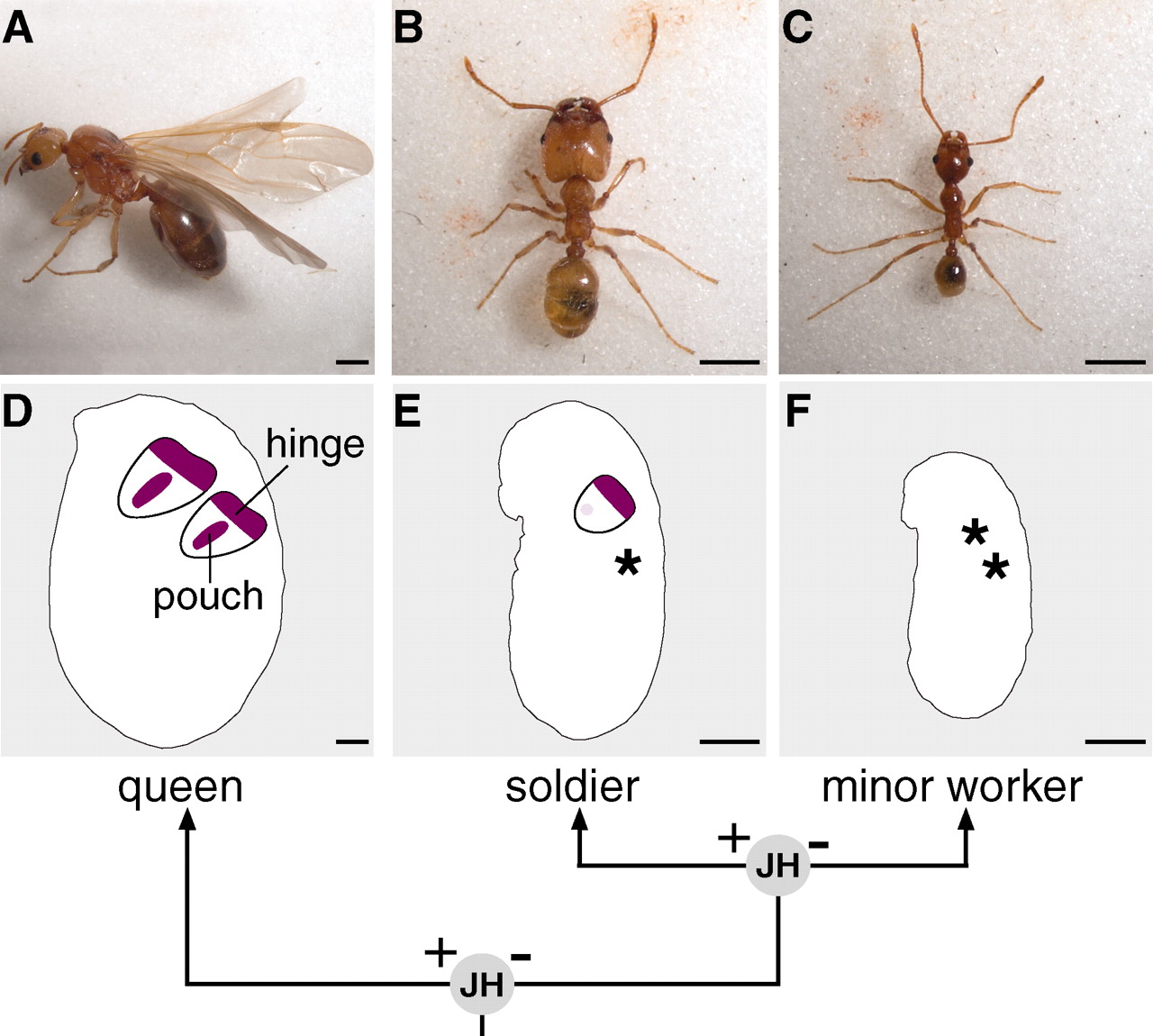
            In many species of the ant genus Pheidole, there are three different castes: queens, soldiers, and minor workers. These three castes are determined by two juvenile hormone (JH) mediated switches in response to environmental cues.  At the first switch the queen and the two other castes are divided, and at the second switch the soldier and the worker castes are separated (see Fig. 1). Queens have four wings, whereas soldiers and minor workers do not have any. Soldiers are bigger than minor workers and have one set of vestigial wing discs, whereas minor workers lack them (see Fig. 1).


Fig. 1: Wing polyphenism in P. morrisi: the ability of a single genome to produce (A) winged queens and wingless (B) soldiers and (C) minor workers. Caste determination occurs at two JH-mediated switch points in response to environmental cues. (D) Wing discs in queen larvae showing conserved hinge and pouch expression of sal. (E) Vestigial wing discs in soldier larvae showing a soldier-specific pattern of sal expression, where it is conserved in the hinge but down-regulated in the pouch. Asterisks represent the absence of visible wing discs and sal expression in (E) soldier and (F) minor worker larvae. Scale bars indicate the relative sizes of queen, soldier, and minor worker larvae and adults. From Rajakumar et al. 2012.
           

In a recent Science paper, Rajakumar et al. (1) showed that the formation of wings of queens is generated by the expression of the sal gene in the wing hinges and pouches (Fig. 1), whereas in soldiers sal is expressed only in the hinges of vestigial discs and minor workers show no gene expression. Interestingly, some species have a subclass called supersoldiers, which are bigger than regular soldiers and have two sets of vestigial wing discs, where the gene sal is expressed. It is known that this type of supersoldiers occasionally appear as mutant forms in the regular three-caste species. Rajakumar et al. then conducted experiments to study whether supersoldiers can be generated in a three-caste species when methoprene (a JH analog) was applied after soldiers and minor workers are separated. They then showed that the application of methoprene induces supersoldiers.

This observation suggests that all species of Pheidole has the potential for producing a subclass of supersoldiers. They constructed a phylogenetic tree for the eleven species examined and inferred the evolutionary changes of the occurrence of supersoldiers (Fig. 2). Their conclusion was that the ancestral species of this group of ants probably had the gene sal but this gene was lost in some descendant lineage. However, the developmental pathway leading to supersoldiers was retained in the genome. Therefore, when a backward mutation occurred at the sal locus in one of the descendant species (P. obtusospinosa), the subcaste of supersoldiers was restored (Fig. 2). They tested this hypothesis by applying methoprene to several three-caste species and found that supersoldiers are indeed inducible by the reactivation of the sal gene.


Fig. 2: Evolutionary history of ancestral developmental potential and phenotypic expression of supersoldiers (XSDs). MYA, million years ago. Purple represents the pattern of sal expression; asterisks indicate the absence of vestigial wing discs and sal expression. Green arrows and boxes represent the induction of XSD potential. From Rajakumar et al. 2012.


This study suggested that apparently independent evolution of a caste system can be due to mutations of regulatory genes controlling the downstream developmental pathways. If this is the case, the various forms of caste systems existing in Hymenoptera could be due to different signal proteins generated by mutations. Kamakura (2) showed that the first switch gene in honeybees is royalactin, but different switch genes may be used in different groups of hymenopteran species. Furthermore, different numbers of switch genes may be involved in different groups. Ethologists seem to believe that different caste systems must have evolved by natural selection. However, if we consider that there are various types of sex determination in insects and some changes among them could be largely due to genetic drift (3), we may have to entertain the possibility of non-adaptive changes of caste systems.

Behavioral evolution is one of the most complex research areas of evolution, and I am hoping that modern molecular biology will be able to solve this problem.


References
1. Rajakumar R, San Mauro D, Dijkstra MB, Huang MH, Wheeler DE et al. 2012. Ancestral developmental potential facilitates parallel evolution in ants. Science 335:79-82.
2. Kamakura M. 2011. Royalactin induces queen differentiation in honeybees. Nature 473:478-483.

Wednesday, March 21, 2012

Honeybee Castes and Altruism


In honeybees the queen and the worker are both females, but the queen has a larger body size than the worker and produces abundant offspring. By contrast, the worker bees are effectively sterile and take care of the queen and her offspring. Whether a female becomes a queen or a worker is determined by the amount of royal jelly provided during embryogenesis. If the amount of royal jelly is high, a queen is produced, but otherwise a worker bee is born. In a recent Nature paper, Kamakura (1) showed that royal jelly contains the protein Royalactin and this protein initiates the development of a queen. Therefore, the presence or absence of this protein generates the castes of the queen and the worker. In a “News and Comments” paper in Nature, Gene Robinson (2) praised this paper stating that Kamakura solved a 100-year old problem. Because the detail of Kamakura’s molecular study is explained by Robinson, I refer the reader to his article as well as Kamakura’s original paper.
In this commentary, I would like to discuss other aspects of evolution of castes and altruism. As is well known, Bill Hamilton (3) published a mathematical paper deriving the condition of evolution of different castes or eusociality. Some time ago, I tried to read the paper, but I was not happy with his formulation. Recently, Nowak, Tarnita, and Wilson (4) re-examined Hamilton’s theoretical work and rejected it. This paper then received hostile responses from the sociobiology community including the five papers simultaneously published in Nature. However, Nowak et al. does not give up their criticism (5). They believe that the caste system in hymenopteran insects has evolved by group selection, as Charles Darwin speculated, and propose one evolutionary scenario of eusociality.
In my view, this problem should be studied by using the molecular approach rather than the mathematical. Kamakura’s study indicates that eusociality can evolve irrespective of haplodiploid or diplodiploid sex determination, because he showed that the ectopic expression of royalactin produces a queen-like female even in Drosophila. This indicates that differentiation of the queen and the worker is initiated by one or a few genes. This finding questions the validity of Hamiliton's principle. The molecular biology of behavioral characters has been studied extensively for more than 40 years after Seymour Benzer’s pioneering work. Of course, the evolution of eusociality is quite complicated compared with the characters studied by molecular biologists. However, it is encouraging that several groups of evolutionists are now working on this subject using various insect species (e.g. 6, 7, 8, 9, 10).
             It is now known that many genes controlling sex determination and eusociality are shared by different insect species, and the expression of several genes is controlled by alternative splicing. For example, the feminizer (fem) gene that initiates the formation of female phenotype in honeybees is orthologous to the transformer (tra) gene in medfly, housefly, and Drosophila, and multiple splicing is necessary for these genes to produce functional proteins.


References
1. Kamakura M. 2011. Royalactin induces queen differentiation in honeybees. Nature 473:478-483.
2. Robinson G. 2011. Royal aspirations. Nature 473:454-455.
3. Hamilton WD. 1964. The genetical evolution of social behavior, I and II. J Theor Biol 7:1-52.
4. Nowak MA, Tarnita CE, and Wilson EO. 2010. The evolution of eusociality. Nature 466:1057-1062.
5. Nowak MA, Tarnita CE, and Wilson EO. 2011. Nowak et al. reply. Nature 471:E9-E10.
7. Rajakumar R, San Mauro D, Dijkstra MB, Huang MH, Wheeler DE, Hiou-Tim F, Khila A, Cournoyea M, and Abouheif E. 2012. Ancestral developmental potential facilitates parallel evolution in ants. Science 335:79-82.
8. Hasselmann M, Gempe T, Nunes-Silva CG, Otte M, Beye M. 2008. Evidence for the evolutionary nascence of a novel sex determination pathway in honeybees. Nature 454: 519-522.
9. Verhulst EC, Beukeboom LW, van de Zande L. 2010. Maternal control of haplodiploid sex determination in the wasp Nasonia. Science 328:620-3.
10. Foret S, Kucharski R, Pellegrini M, Feng S, Jacobsen SE, Robinson GE, and Maleszka R. 2012. DNA methylation dynamics, metabolic fluxes, gene splicing, and alternative phenotypes in honey bees. PNAS Early Edition.